Bambee

Year
2018
Industry
B2B SaaS + HR
North Star
Pair every small business in America with a dedicated HR manager
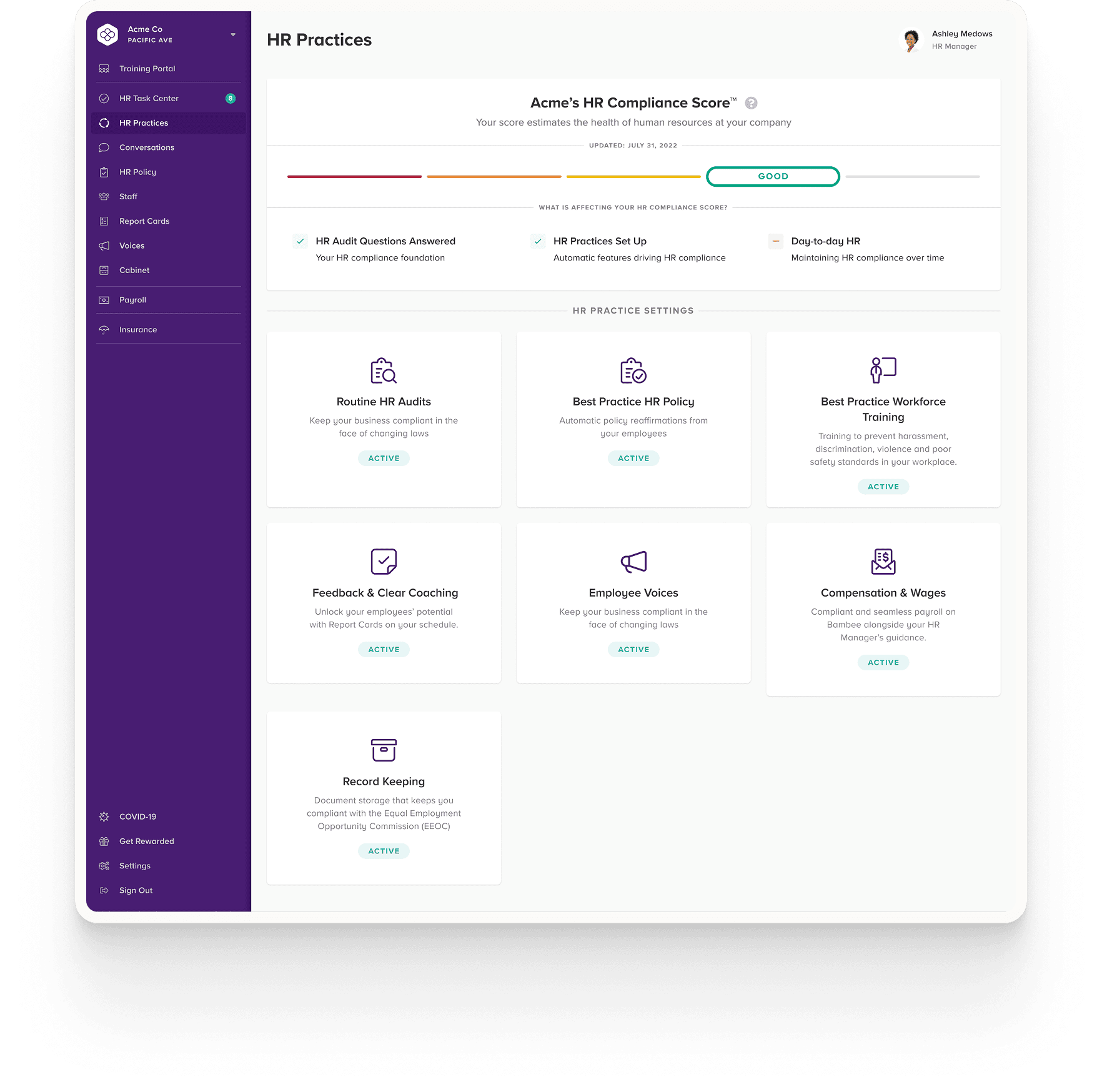
The most unusual part of this role was operating at the founder's vision altitude and the engineering team's execution altitude at the same time. These were not the same reality.
At the vision altitude, I worked directly with the founder to produce the artifacts that raised $65M across seed through Series C: pitch decks, interactive Figma prototypes, and clickable demos of product experiences that didn't exist yet. Some of these became real product. Others would have required partnerships that never materialized.
At the execution altitude, every vision artifact had a shadow deliverable: the buildable version. Prioritized feature sets, design specs, and engineering-ready roadmaps. The discipline was knowing which altitude any given meeting required, and being transparent about the gap between them without undermining either.
The gap between vision and execution is real, and it should be. Concept cars raise money. Production cars serve customers. The designer's job is to make both honest without pretending they're the same thing.
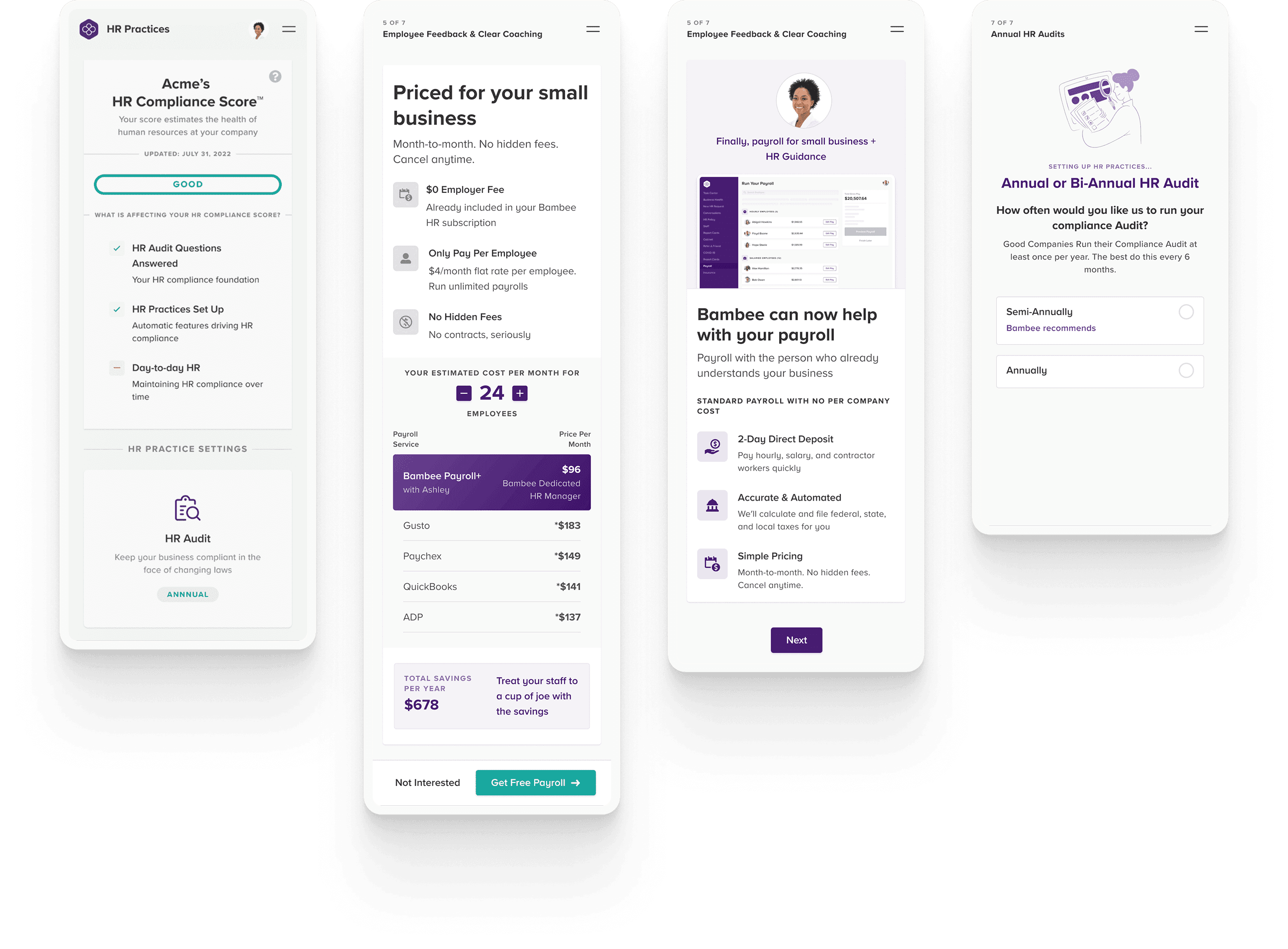
The onboarding funnel was Bambee's primary revenue driver, and every design tension in the business lived inside it.
The founder chose five bracket-based pricing tiers over the per-seat model I pushed for. The consequence was predictable: a company with 26 employees would claim 25 to dodge a tier jump worth thousands annually. Rather than pretending the incentive didn't exist, I designed around it. The flow collected accurate headcount through onboarding itself instead of trusting self-reported numbers at checkout.
Onboarding a 4-person shop is a different product than onboarding a company with 100 employees, so I designed adaptive experiences that changed shape based on company size. Small businesses with fewer than ten employees got a conversational, linear flow with minimal uploads. Mid-size companies in the 11 to 50 range got a guided flow with document categorization. Larger companies above 50 employees got bulk mode with CSV parsing, batch upload, and OCR-based document sorting.
All document processing used traditional workflow engineering: optical character recognition, automated sorting, and compliance document classification. This was 2017 through 2022, entirely pre-AI. The system parsed uploaded documents, identified document types, extracted key fields, and routed them into the correct compliance categories without machine learning.
There was also a channel reality that shaped the design. Some customers completed onboarding in the browser. Others needed their HR manager walking them through it over the phone. The flow had to function as both a self-serve product and a real-time guided experience, the same screens supporting two completely different modes of use.
Bambee wasn't a SaaS product with an admin panel. It was two products sharing a data layer, each with fundamentally different users and fundamentally different needs.
The customer-facing product had to feel like talking to your HR manager rather than filling out forms. Every screen balanced simplicity for the 4-person shop that had never touched HR software against density for the growing business that needed compliance dashboards, employee records, and policy management. The design system I built gave that spectrum a shared language: same components, different compositions.
The internal HR manager platform was where operational complexity lived. HR managers needed a unified timeline of all customer interactions in chronological order across chat, phone, and email. They needed customer context that survived manager transitions mid-engagement. They needed compliance status dashboards per client with state-specific regulatory tracking and guided workflows for high-stakes processes like terminations, policy reviews, and benefits administration.
One experiment that didn't work: I built structured communication-style profiles, a widget measuring coaching preference, directness, and formality, so a new HR manager could quickly read how a client preferred to interact. It was conceptually sound and it didn't stick. Free-form notes won. When you're designing around a human relationship, the software has to bend to the relationship rather than the other way around. Flexible tools beat structured ones when the relationship is the product.
The highest-stakes product surface. Getting it wrong had direct legal consequences for Bambee's customers.
The guided termination process was a multi-party compliance workflow that gathered context from the existing customer relationship, ensured every step was compliant with state-specific regulations, generated legally required documentation, routed paperwork to the correct parties, and created an audit trail that protected the customer in court.
This was Bambee's original product, a standalone compliance tool, and I had to redesign it to work within the broader HR manager relationship model. The information architecture challenge was significant: a tool that previously assumed a transactional interaction now needed to understand relationship history, manager context, and ongoing customer dynamics.
The workflow engine tracked state transitions across multiple actors, enforced ordering constraints on document generation, and maintained a complete audit log. The compliance logic varied by state jurisdiction, with California alone requiring different handling than 40 other states combined. Every path through the workflow had to produce a defensible paper trail.
I hired and led a design team of three through six years of growth, pivots, and a founder who dreamed faster than anyone could ship.
In a small org reporting directly to the founder, "Director of Product Design" meant three relationships at once. Managing up meant aligning with a founder whose vision shifted fast, pushing back when design integrity was at stake, and translating ambition into feasibility without killing the ambition. Managing across meant working with engineering's real constraints around timeline, technical debt, and team capacity, and spending significant time protecting user experience from being the first thing cut when scope got tight. Managing down meant growing designers who could operate when priorities changed weekly and making sure the design function held together even when organizational attention moved elsewhere.
Over six years, the team shipped the complete customer platform, the internal HR manager platform, the end-to-end revenue engine from marketing site through onboarding, the investor narrative across rounds totaling $65M, and a foundational design system that gave engineering a shared vocabulary across multiple product lines.
The company went from seed to Series C, five people to 200, zero customers to 10,000 businesses, $25M ARR, with three designers behind every surface. And the best design insight from six years of working with reluctant users was that the best software earns trust from people who'd rather just pick up the phone.
Six years. Zero to 10,000 businesses. $25M ARR. $65M raised. Three designers behind every surface.